All about Unmanned Aircraft, Robots and Active Laser Technology
Matthias Erler of GIT-SECURITY.com spoke with Ulrich Skubsch and Manfred Müller
Civil danger management, where accidents or natural catastrophes occur, but also terror attacks or for frontier security - that is the business of the "Homeland Security" division of Telefunken Racoms. The company provides system solutions to support authorities, organizations and task forces. Matthias Erler of GIT-SECURITY.com spoke with Ulrich Skubsch (Independent Marketing Consultant, Homeland Security) and Manfred Müller (Head of Marketing and Projects) at Telefunken Racoms.
Mr Skubsch, Mr Müller, let‘s first of all take an introductory look at the subject of digital radio for the emergency services in Germany. Can you give us your opinion of the current situation please?
U. Skubsch: The emergency services have been using analog radio up until now, a communications technology that frequently stood out because of its hissing and black spots. Even the new digital radio technology that we now have has shown some dead spots in practice that can be compared to those in GSM mobile radio. Unbeknown to the speaker, the sound is suddenly no longer transmitted, or it arrives incomplete and with gaps. It is a macabre situation that we have been in a sort of definition phase for 12 years now, during which a great deal has been discussed. Then it was finally decided to use a system that does not comply either with those of neighboring countries nor with the EU regulations, the so-called ETSI standard. The devices are not compatible, which significantly impedes information exchange, for example, during a terrorist attack. At the moment it is sometimes not possible, even just beyond city borders, to communicate with the fire brigade of the next community.
What can your company do to counter this?
U. Skubsch: Telefunken Racoms links analog and digital communications technology; incompatibilities are simply bridged. Everything is incorporated into a system that networks sensors, management and even the tactical measures together.
Could you give us a practical example?
U. Skubsch: Critical infrastructures, such as an airport for example, need not only the airport and local fire brigade but also support from others when handling emergency situations, such as the fire brigade of neighboring towns. This is where the first difficulties arise: does the adjacent county have the same radio equipment? There are also similar problems at large industrial sites, at railway stations, in short everywhere that lots of people are on the move, are working or otherwise spending time together.
You have grouped your products together under the title of "Homeland Security". Could you explain this term to our readers?
U. Skubsch: I must point out straight away that we are going on the assumption that the broad title of "Homeland Security" hasn‘t really been defined here in Germany yet. We have been trying for over a year to synchronies the appropriate authorities and organizations on this point during congresses, conferences and in our own premises. The term has taken on a sad association since the attack on the twin towers in New York and internationally has been given totally different meanings since then. We cannot simply transfer this term "Homeland Security" to German conditions, above all because of our federal system in which there is, in practice, no point of contact, for all matters concerning the army for example, that is solely responsible for all associated tasks. We therefore have to speak to 16 different states as well as the federal police.
So you have to carry out a sort of association job in advance?
U. Skubsch: Fundamentally we do more that that. In contrast to an association, we look after not only the interests of those with a local, company-specific background but also those that have a nationwide economic relevance - the experience of Telefunken with the military helps us here. As the Chancellor Angela Merkel encouraged us in 2008 to more closely integrate military experience into civil use, we were quickly able to demonstrate concepts that envisage the cooperation of all involved institutions, such as the civil protection authorities, the fire brigades, the German governmental disaster relief organization (THW), police forces, special forces, the interior ministries etc. As a traditional company we are able to provide tailor-made solutions to the specific German requirements, in contrast to globally oriented concerns that operate differently. At the same time, through the history of our concern, we have access to products that have already been field-proven in Israel, products for all the tasks that you can consider "Homeland Security" technology.
What distinguishes these concepts that you just mentioned in detail?
U. Skubsch: One can best understand our broad approach when one considers the problem of nationally restricted financial resources: one cannot simply rebuild everything that‘s necessary from scratch, so a really good solution is characterized, above all, by the most flexible methods and integration. And that means, first of all, that any concept must take the installed base into account - our concepts do exactly that: both analog as well as digital radio is integrated, the most varied management systems, starting from the smallest facility management or the largest danger management system, the most varied camera systems - all these are incorporated. That cannot be achieved with ‚off-the-shelf‘ products but only with solutions that are specifically adapted to the customer.
We‘re not just talking here about ‘customizing' then, but generally about a strongly consultancy-oriented concept?
U. Skubsch: It is a C4I Master Concept (Command, Control, Communications, Computer, Intelligence) that is devolved from the military. Telefunken Racoms already has numerous management systems for fire alarm systems, for video surveillance and generally for danger management, extending to heating, ventilation and air conditioning. The connection of these individual systems to one uniform system is important here.
Mr Müller, could you explain to our readers what products your company can offer to manage the scenarios just outlined by Mr Skubsch?
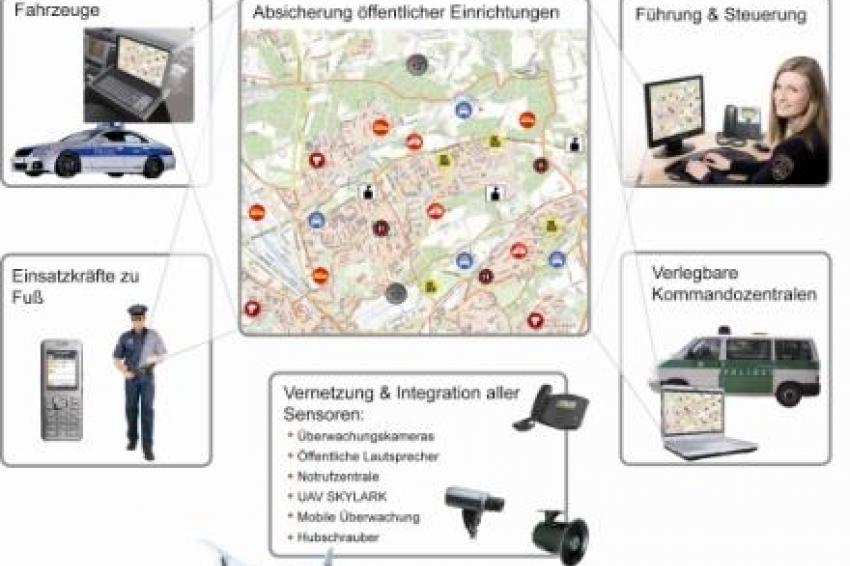
M. Müller: First of all, such a risk management system consists fundamentally of three parts: the sensors, the real management system with the user interface and thirdly a subordinated technology that can react automatically or respond to a user command. We can include high-value systems within the sensor framework, such as cameras with a very long range that can recognize or even identify extremely distant objects even under the most adverse conditions, such as fog and rain. For example, we offer night-vision technology that can be used for coastal protection to observe ships at 8 km range and to help read their name. We should also mention our unmanned vehicles that can be used on land, on the water and in the air, wherever it is too dangerous for people.
You mentioned management systems as your second focal point?
M. Müller: The most important element here is presentation of the situation. Relevant events can be analyzed with the help of video technology. Just as important is the subject of communication: with our systems, we are able to secure gateways from one radio network to another and thereby bridge the frequently occurring incompatibilities. The overlying technology is networking: the control center is not simply there where it was built at some point in the past but instead where it is actually needed. We can transfer it wherever it‘s needed with just a few clicks of the mouse - a browser-supported technology. "Safe City" is the name of this concept. It uses open interfaces so that we can incorporate the installed base just as well as new technologies. In this way we can adapt to the local requirements in every situation, regardless of whether it is a frontier, a stretch of coastline or the surveillance of an inner city.
Let‘s move onto the third part of your concept which handles the actual danger measurement measures.
M. Müller: Besides alarming, this also includes the reactive systems. When a terrorist attack occurs, we must assume that certain infrastructures must be automatically blocked, just as other countries already do today. When it is recognized that explosives are being triggered via the mobile phone network then all base stations could be switched off so that further ignitions are not possible. Further, we are able to apply so-called jammers. With these, and for the protection of the civil population, every radio-based communication can be either completely suppressed or selectively so interfered with that, for example, only the rescue services can still communicate with each other. The use of this technology is however not sufficiently regulated in Germany.
Mr Skubsch, your face-recognition systems were mentioned before - why are these as powerful as you have described them?
U. Skubsch: Today‘s very widespread thermal imaging technology reaches its limits where things have to be identified that themselves do not recognize any heat. What is written on the sign next to the targeted person? What is the adjacent car up to? Our systems work with active laser technology which originated in military applications and is now available for civil applications for the first time. We can now identify precise details even in situations where the human eye would no longer recognize anything, even supported with spotlights, for example in fog, through foliage, snow or rain.
This technology was not available for civil use until now?
U. Skubsch: We could jokingly say that we pick up where James Bond left off ... But, as I said, it is a technology that until now has only been developed and used by the military, where totally different budgets are of course available. Here we are only talking about products however that, for civil use, have been broken down into their individual elements, also financially.
Does that also apply to the other products that you mentioned?
U. Skubsch: For the most part that applies to all the products that we offer for applications on land, on water and in the air. That includes the Skylark I, an unmanned aircraft that flies completely automatically so that the user only needs to concentrate on remotely controlling the camera. It can land anywhere, if necessary on the helicopter platform of a customs cruiser in the Baltic Sea. One of our own developments is the Telestat. This is a sort of tethered balloon that, as such, falls outside the competence of the Federal Office of Civil Aeronautics and is therefore legally permitted. The usual problem here that every gust of wind brings conventional balloons down does not happen here because the Telestat, like a kite, is instead driven up by the wind. We can install cameras, relays etc. on this.
Can we go overland now?
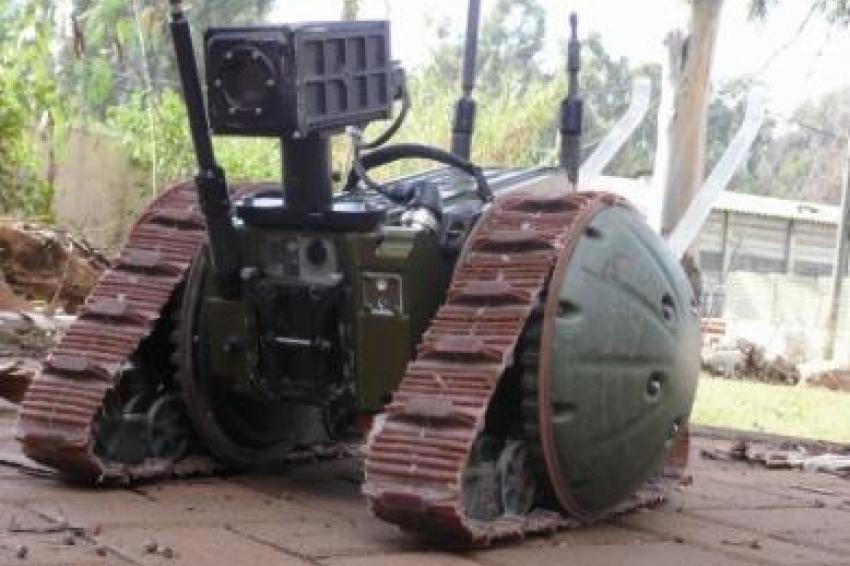
U. Skubsch: Here we must mention the Viper, a vehicle with a special wheel construction: it has a variable track drive and is therefore able to drive across otherwise impassable ground, damaged houses, through water and also through sand and undergrowth. Gas detectors, grapplers, cameras etc. can be fitted on it so that information can be obtained without putting people in danger. Guardium is the name of the larger model - it is used, for example, in frontier surveillance. Finally, on the water: the "Silver Marlin" powerboat cuts through the sea at high speed and can carry out a search for people or objects in the sea in a very precise way and also recover them. So we are able to apply our technology in all the elements where people would otherwise be in danger.
Mr Skubsch, Mr Müller, many thanks for the conversation.
Contact
Telefunken Radio Communication Systems GmbH & Co.KG
Eberhard-Finckh-Str. 55
89075 Ulm
Germany
+49 731 1553 0
+49 731 1553 112