Integrating Fence Detection and Video Analytics
29.05.2012 - Port of Charleston is one of the busiest container ports along the United States' Southeast and Gulf coasts. Moving more than 600,000 pier containers per year and ranked 8th larges...

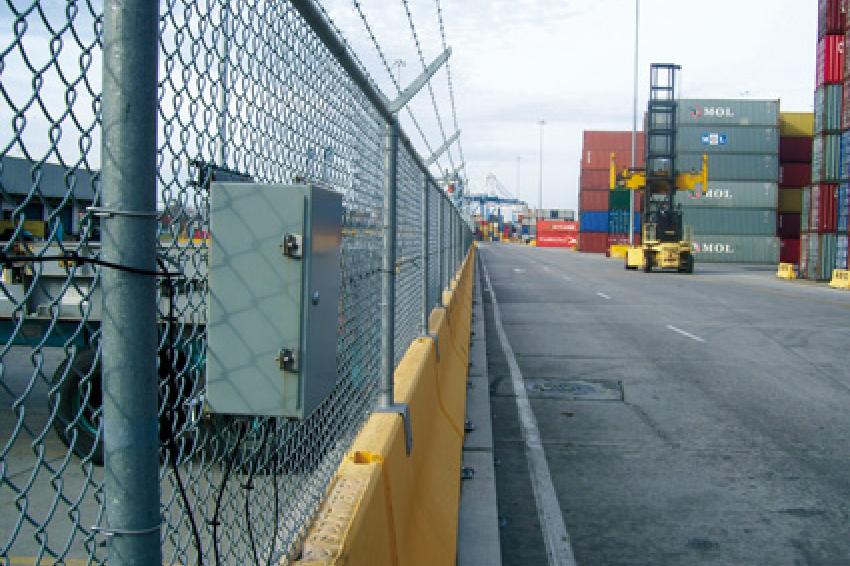
Port of Charleston is one of the busiest container ports along the United States' Southeast and Gulf coasts. Moving more than 600,000 pier containers per year and ranked 8th largest U.S. port in cargo value, with $50 billion in annual shipments, Charleston is recognized as North America's most efficient and productive port. As a vital hub for global freight transfer, implementing a site protection solution that would safeguard facility infrastructure without adverse affect to flow of cargo was a critical goal.
Wando Welch Terminal is Port of Charleston's largest terminal, both in cargo volume and physical size. Jeff Brown, HNTB consultant and contractor to South Carolina State Port Authority, has managed the SCSPA security program since 2005. Overseeing perimeter protection and access control for the Port's terminals, he was tasked with enhancing Waldo Welch's perimeter security system. As the Coast Guard representative responsible for reviewing South Carolina State Port Authority's facility security plan, Jeff Brown evolved into directing Port of Charleston's security operations when a consultant with his credentials was needed to customize a plan complying with new legislation.
Identifying the Challenges
In evaluating program options, Brown considered the Port's unique security challenges. Prior to 9/11, ensuring secure transfer of cargo was a key focus at Wando Welch Terminal, and roving patrols by Port Police managed loss prevention. With the prospect of terrorist breach, a system that could reliably detect and monitor disturbances at the perimeter became the new paradigm.
A must for Brown was finding a solution that successfully addressed a marine environment; one that remained in near constant motion between ship, vehicle and foot traffic. This scenario would trigger nuisance alarms in most security systems, so the new system needed the intelligence to recognize and ignore traditional environmental disturbances to avoid desensitizing monitoring personnel with false positives.
Another challenge was balancing the divergent priorities of airtight terminal security and efficient cargo transfer. By definition, complex counter-terror measures had the potential to slow the pace of a facility consistently recognized for high productivity. It was imperative to narrow the solutions to those that delivered superior intrusion detection without being cumbersome to administrate.
"At the very core, Port Operations and Port Security are 180 degrees out of phase because Operations wants to move cargo as quickly as possible. It's all based on turn times," Brown explained. "But you've got shipping lines that rely on the Port Authority to securely transfer their cargo and 105 Regulations in place, so Port Police needs the security of the terminal ensured."
Brown describes working through these conflicting issues as one of the most difficult functions he performs, and cites strong communication as the key to effectively bridging the gap between Operations and Security. He coordinates closely with port operations, engineering, IT and maintenance teams. He also regularly consults port police, customs and border protection, the U.S. Coast Guard, and Project Seahawk - an innovative pilot program at Port of Charleston created by Congress under the guidance of the Department of Justice to enhance port security operations, capabilities and coordination. By understanding and addressing the needs of each of these constituents, Brown has managed to deliver a security program that satisfies all parties.
Developing Plan
Mapping out security program expansion guidelines for each of the facility's five non-continuous terminals was Port of Charleston's greatest challenge. "105 Regulations say that you have to monitor your perimeter and access points, but it's up to the individual entities to figure out how to comply," Brown explained.
To address this responsibly, Brown and his team formulated a comprehensive Security Improvement Plan - an industry best-practice concept incorporating solutions that delivered the protection required by Port Authorities, and addressed the risks identified by the Port during vulnerability assessments. "To put together a plan of this magnitude, we had to take a holistic approach," outlined Brown. "There was extensive coordination between Operations and Security. Each of the Port's various internal and external constituents were consulted."
Traffic flow at each terminal was evaluated toward restricted area boundary redefinition, and detailed site diagrams and project cost estimates were developed. The plan eventually included equipment design and performance specifications for the initial upgrade at Wando Welch Terminal. "This master plan has been critical to the success of Port of Charleston's security program," Brown emphasized. "All affected parties agreed on it. Everybody understands what is expected, how it will be delivered and what the price tag will be." In fact, Brown reports that the plan's elaborate detail has been an important factor in the Port's ongoing success in securing grant monies for bringing the security upgrades to fruition.
The Integration Partner
Upon plan approval, Brown tackled hiring a systems integrator to handle the installation. To attract only highly qualified candidates, he employed rigorous selection criteria that included evaluation of each firm's technical certifications, breadth of manpower, implementation history for similar systems and quality assurance parameters.
"We had our design, so everyone would be delivering the same product," Brown recalled. "I wanted to know how a prospective partner would strategically approach the installation, and what they would do to set themselves apart. We expected a thorough plan of action." Port of Charleston ultimately selected I-Sys Corporation of North Charleston, South Carolina. Along with capabilities that satisfied Brown's stringent requirements, I-Sys committed to providing a level of service that included 24-hour response time, 72-hour resolution of issues and a 3-year warranty on installed product.
An Intelligent Solution
According to Port of Charleston's Security Improvement Plan, a key requirement of the new perimeter system was its ability to precisely locate fence line breaches and monitor intruders from point of attack through incident resolution. Brown acknowledged that it would be unmanageable and costly to install cameras along every linear foot of its irregular boundary for this purpose. Instead, the Port chose two market-leading intelligent detection solutions: Southwest Microwave's Intrepi MicroPoint Cable fence detection system - which offered pinpoint intrusion location and tie-in of detection zones to CCTV camera presets - and PureTech's PureActiv wide area video surveillance system - which successfully identified and tracked qualified targets.
"There weren't many companies who could deliver what we wanted," said Brown. "We went through an exhaustive process to ensure that we were going to get the most appropriate, best of breed perimeter security system."
The synergistic solution they selected enabled the Port to strategically place visible light, infrared illuminated and thermal pan-tilt-zoom cameras controlled by the PureActiv system at key points along the perimeter, and integrate them with the MicroPoint Cable system to quickly locate and react to intrusions across the port's vast property.
"We chose MicroPoint because it was the only sensor that could detect to within 3 meters and direct camera PTZ activity to incident location," Brown explained. "PureActiv provided intelligent video analytics, 3D geospatial command and control, autonomous PTZ tracking and open architecture which easily integrated with MicroPoint and our Lenel access control system." Brown recognized that the Southwest Microwave fence detection system had been successfully paired with PureTech's video analytics package at other sites, including City of Phoenix Water and Tucson International Airport. "The fact that this was not the first time these two products have been integrated, that all the kinks had been ironed out, was invaluable to me."
Extensive Testing
Once the MicroPoint Cable/PureActiv system was installed, the Port's security team, I-Sys Corporation and PureTech conducted thorough performance verification testing to ensure round-the-clock functionality at every point along the fence line. "We painstakingly went to each camera and had an ‘intruder' run, walk, roll, crawl and climb the fence to ensure that cameras and fence sensors worked properly," said Brown. With an extensive array of PTZ cameras, this endeavor took weeks to complete. While Brown concedes that the testing was more rigorous than most, results were overarchingly positive. "I expected our vendor to prove to me that the system was ready to do what it needs to do," Brown recalled. "They knocked it out of the park. It was an amazing success." In fact, Brown remarked that in general, the new solution far exceeded his expectations both during the testing phase and initial implementation.
A Solid Solution
Port of Charleston's new perimeter detection system solves the facility's main concerns, terrorist breach and cargo loss. Southwest Microwave's Intrepid MicroPoint cable system allows the Port to confidently pinpoint a cut or climb attempt to within one fence panel. PureTech's PureActiv system reliably analyzes disturbances, then smoothly tracks and manages qualified events until they are resolved.
Each product has contributed to solving environmental nuisance alarm issues common to other detection technologies. MicroPoint effectively identifies fence attacks while ignoring distributed environmental disturbances such as truck traffic at the Port. PureActiv copes exceptionally well with the diversity of port environments, including busy waterside cargo loading areas, long fence lines, active roadways and controlled entrance and egress points.
The solution has delivered the port a cost-effective system for detecting intrusions along a lengthy perimeter, and an efficiency that reinforces both systems' smart sensor capabilities. The ability to assign detection zones in system software at any point along the cable has reduced hardware requirements and simplified assessment. PureTech's analytics can identify targets at long ranges, minimizing the required number of cameras and simplifying monitoring processes. By employing standard cameras, the system further reduces cost and gives the port installation flexibility without compromising detection standards.
"I could not be more pleased with the new system," Brown stated emphatically. "I do not think there are other products out there that do what MicroPoint Cable and PureActiv can. These solutions are so well integrated that I almost forget that they are two separate systems. The entire perimeter security system performs the way it's supposed to. If every system I implemented worked as well, then my job would be easy."